Friday, September 23, 2016

Working - How a Debt Fund beats a fixed deposit post tax

I have received many requests to give a working of how Bond Funds beat fixed deposits post tax. When you invest in an FD, you pay tax at your tax slab which could be 30%. However investors in bond funds get the benefit of indexing the cost and a reduced rate of 20% tax which significantly reduces tax burden.

Assumptions in the sample below:
1. Investment has to be for 3 years for indexation benefits for bond fund
2. Cost inflation index growth at 5% which is very reasonable considering the rate of inflation
3. 7.25% returns for both
Even with the same returns, the net gain at the end of 3 years is substantial if one had invested in bond funds


Mutual Fund investments are subject to market risk. Please read all scheme related documents carefully.

Connect with me at maheshmirpuri@yahoo.com to learn more about mutual funds.

Wednesday, August 31, 2016

Aashish Somaiyya, MD, Motilal Oswal AMC answers a few of my questions on their upcoming NFO


Congratulations Aashish, on the sustained good performance of the schemes of Motilal Oswal AMC and on become one of the fastest growing fund houses in the equity segment. It is great to see an equity focused AMC with a strong emphasis on process doing well.

You are launching your MOSt Focused Dynamic Equity Fund on 6.9.2016 – a fund which allocates investor money dynamically between Debt and Equity - and it would be great to get some details from you on this.

Balanced funds / Dynamic-asset allocation funds as a category have done very well in the last couple of years. Are you a bit late in launching this fund?

The appreciation for a concept like Dynamic Equity is higher when markets are very volatile. In the last 12 to 15 months we have seen 9000 on Nifty and then 6700 as recently as Feb 2016 and now again we are near 8700 as we write this. In such an environment you would expect that a Dynamically managed fund which calibrates equity allocation would perform quite well. Due to recency bias, such funds are popular currently and strictly from that perspective one can say we are late! But just like change is the only constant, when it comes to capital markets, volatility is the only constant and from that perspective such funds can never be in our out of vogue. They are ever-green solutions for one of the biggest challenges of equity investing, that of volatility.

Can you explain a little to investors on how an investment in this scheme will work for them?

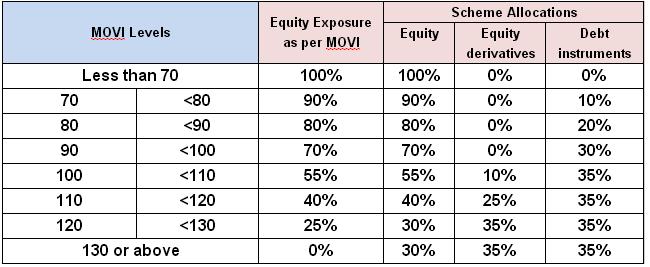
The Scheme through dynamic asset allocation aims to generate reasonable returns even in volatile markets.  A low MOVI level (our proprietary index) indicates that the market valuation appears to be cheap and a high MOVI level indicates that the market valuation appears to be expensive.  The equity exposure percentage based on the MOVI levels is depicted below.


The Scheme conducts asset allocation between equity, Equity derivatives and debt instruments based on the MOVI levels.


Equity: The Fund shall follow an active investment style using bottom-up stock picking based on the ‘Buy Right : Sit Tight’ investment philosophy. The Fund managers shall identify and invest in shares of businesses run by high quality management & having sustainable and scalable business models thus using QGLP (Quality, Growth, Longevity& Price) as the key evaluation parameters.

Debt: The Fund shall invest in various types of permitted Debt Instruments including Government Securities, Corporate Debt, Other debt instruments and Money Market Instruments of various maturities and ratings with the objective of providing liquidity and achieving optimal returns. The fixed income component will be passive in nature.

Arbitrage and Derivative Strategies: The Fund shall undertake Cash/Futures Arbitrage to take advantage of the volatile situation in the market. The Fund may use Derivative including Index Futures, Stock Futures, Index Options and Stock Options etc.

Following depicts more clarity on MOVI based Scheme allocation.


Scenario 1 - Let’s assume the MOVI level is at 60 which means it falls in the range of 100% equity allocation. Therefore, the fund manager in the above case will take upto 100% long only equity exposure.

Scenario 2 - Let’s assume the MOVI level is at 100 which means it falls in the range of 55% equity allocation. Therefore, the fund manager in the above case will take 55% long only equity exposure and minimum 10% in equity derivatives or hedged exposure. The balance upto 35% will be invested in debt instruments.

Scenario 3 - Let’s assume the MOVI level is at 150 which means it falls in the range of 0% equity allocation. Therefore, the fund manager in the above case will take 30% long only equity exposure and minimum 35% in arbitrage opportunity. The balance upto 35% will be invested in debt instruments.

Can you share the results of a 10 year back test done using the investment pattern of MOSt Focused Dynamic Equity Fund and a graph/graphs comparing with the NIFTY?

The historical back testing of the dynamic asset allocation on the Index (Nifty 50) suggests that the rebalancing provides better return than the Index with very low volatility.


Index-Nifty
Index (Nifty)Rebalanced
Annualized Returns
12.73
13.34
Standard Deviation
23.68
14.47

Index – Nifty 50; Index Rebalanced - Nifty 50 rebalanced based on MOVI levels
Index and Index rebalanced are rebased to 10 as on 1st January 2004

However when applying the dynamic asset allocation to Value PMS strategy of Motilal Oswal AMC, the results are different. While annualized return reduces by few percentage points, the volatility is cut in half.  Here we are taking liberty of using Value PMS strategy because that’s the longest running embodiment of BUY RIGHT : SIT TIGHT investment philosophy that we practice. Please note this below chart is only for explaining how MOVI rebalancing works, it meant for this discussion and it is not meant to be circulated to investors or used as marketing literature.


Since Inception
Value Strategy
Value Strategy Rebalanced
Annualized Returns
26.10%
22.73%
Standard Deviation
21.13
12.64


You had once mentioned in a column that alpha comes from the right asset allocation in place. Essentially, in this scheme you are deciding the asset allocation for the investor?

I personally believe that an asset allocation decision is to be made by the investment advisor or distributor in conjunction with the client and yes the larger decision is to be in the right asset class; that’s what produces alpha or what is called advisor alpha before we get into seeing the fund managers alpha. But this logic works when an investor has maturity to view his performance at portfolio level and not at product level. We don’t have that maturity in the system yet.

As far as I am concerned I don’t even see the Dynamic Equity Fund as a segregated scheme. It’s a solution to a problem that we face. If I had it my way I would continue to offer what we have always offered i.e. MOSt Focused Multicap Fund and a MOVI index for taking asset allocation calls in and out of equity. This is why even now this Dynamic Equity Fund will have a passive fixed income allocation and the equity will be similar to our multicap fund. But some of these beliefs of mine are as of now only theoretical and difficult to execute but in future they will be more practical.

 There are few issues we have faced:


·        Investors see performance product by product and not at portfolio levels so a fund like Dynamic Equity has the great ability of improving investor experience amidst volatility and enhance their stickiness and willingness to remain invested

·        There are taxation issues with switching asset allocation on an inter-scheme basis hence it is more efficient to do it intra-scheme by maintaining 65% equity and equity arbitrage

·        There are emotional biases which prevent people from making right asset allocation decisions, since these get hard-coded in the scheme structure they will surely get implemented


·        Volatility is a reality and volatility is here to stay, instead of worrying about it we need to create structures that benefit from the volatility
·
Let me also tell you what are the issues with making a Dynamic Equity Fund kind of structure
  • The asset allocation decision which according to me is an investment advisor or distributors decision after understanding the client’s requirements, is being outsourced to manufacturer like us by embedding it into the product itself
  • We are pandering to the client’s requirement of viewing performance product by product not at portfolio level, this is slightly regressive instead of advancing client behaviour in the right direction
  •  If equity and fixed income are managed separately some discretionary decisions can be taken by clients and intermediaries to enhance performance or to improve liquidity of the investment, which now would not be possible
You are known for your straight talk. Why should investors choose this scheme from your basket of schemes?

I think the concept has been explained clearly up this point in our discussion, and there are similar funds which are available in the market. First of all someone should consider us only if one believes in our philosophy of BUY RIGHT : SIT TIGHT and hence it follows that wealth is created by holding high quality companies through their entire earnings growth cycle. Secondly, the MOVI index is proprietary to us and it is quite comprehensively designed, as you might have seen from the back tested data the concept seems to have worked in the past. This fund is a good combination of bottom up fundamental stock picking with top down asset allocation decision making with macro market level indicators.

Thank you Aashish for giving us comprehensive responses and wishing you success.

Contact me if you wish to invest in this NFO

Mutual Fund investments are subject to market risk. Please read the scheme documents carefully before investing 


Saturday, July 9, 2016

Are you in control?


Are you in control?


Over the last couple of weeks, I have been inundated with queries from investors on Brexit, Rexit, equity outlook, how investments will be affected, which way the markets will move etc. The happenings and consequent media noise has confused many. Investors like to listen to anyone who “has an air of authority” and thus listen to various, often conflicting statements made by “analysts / experts” on various media. Speaking to many investors, I found that much of their fear and confusion was because they were not in control – had jumped into investments without really knowing what they were doing.

A change in the way you approach your investing will keep you in charge. Ask yourself and answer the below two questions.

Is there a direction to your investing or are you driving around aimlessly with no actual destination in mind?

Many of us just invest “to make money”. There is no clear destination in mind. Only when you have a certain destination in mind, will you take the appropriate route. Without a destination, it will be aimless wandering, allowing yourself to be tossed around with the happenings and market ups and downs.

Right from the time we were conceived, plans were made to get us into some school! Yes, some schools ask parents to register the child for admission on conception!! A great deal of planning and effort is put into getting into the right university course and then a post graduate course. The direction of one’s life is planned very well. Then we land that great job and start earning. This is where planning (financial planning) goes missing and haphazard or random investing starts – to save taxes, to get some returns from insurance and of course to make some money also from real estate, equity etc.

Now suppose, you write down your financial goals which may be varied and many, and work out each investment towards achieving that goal, won’t it provide a great direction to your financial life? You won’t be aimlessly driving around affected by all the noise. You are focused and much more in control of the situation. In many cases one may need an advisor to help in this process, in deciding asset allocation and selection of appropriate products and intelligence is taking help if one needs it. Once appropriate investments have been made keeping the destination in mind, you will be less affected by all the noise around. You are in control when your financial life has a direction.

Do you fully understand what each investment entails?

We often invest based on tips received from various fora - whats app groups, SMS and advice from “informed” colleagues, promises of bank relationship managers. While we may know what we have invested in, do we really understand the details and the fact that things may not go as planned or what we buy will not give what is seemingly promised? I find investors investing in equities and other instruments, with not much clue of the possible downside. Worse still, investors get stuck in endowment insurance policies, other products sold by bankers not having any idea of what they will really get and how they fit in to their financial plans.

A little effort to understand what exactly you are investing in, how it fits in to your financial goal will go a long way in keeping you in control. When an advisor, a banker or an insurance guy shows you details of a product, ask questions, plenty of them. Only when you know each and every detail in simple layman’s language, should you invest in a product.

“Know what you own and why you own it” - Peter Lynch. As a start, give yourself answers to the above two questions and you will find you are more focused and in control of your financial life and far less swayed by the noise and the volatility in the markets.

Write to me at maheshmirpuri@yahoo.com


Friday, April 1, 2016

A new financial year - time to take stock and review

We start a new financial year today and wishing all a successful year.

I used to be in the retail business for  several years and the end of the year was busy "taking stock". The habit continues - taking stock, reviewing and planning for the year ahead. Just sharing some thoughts.

The Nifty has moved smartly from 7216 on 10.2.16 to close at 7738 on 31.3.16. However, the index is down almost 9% for the year. FIIs have re entered the market in Mar 2016. However, their net sales last year have been about Rs. 45000 crores In 2015-2016, Domestic institutions  turned buyers with a record net purchase of about Rs. 80000 crores last yearThere has been a sharp rise in equity MF inflows and we now have greater than Rs. 2500 crores of SIP every month.

While we do have an eye on the market, what must be of prime importance to us is our goals and the movement forward we have made towards our goals. We only encourage investing with a specific goal in mind and every investment must be aligned to our goals.

The beginning of a financial year is a good time to review how we moved forward and ask a few questions

  • Do I have adequate life insurance? Have I adequately protected my family in the case of an unfortunate event?
  • Do I have sufficient medical insurance?
  • Have I created an emergency fund and is it adequate?
  • Have I noted down - yes, written down each of my financial goals?
  • What is progress of my movement forward towards my financial goals?
  • Have I done a review of my portfolio? Many of us have portfolios too cluttered with old funds, too many stocks, other investments all made haphazardly in the past which makes it difficult to monitor and maintain.

I do stress on writing down goals. This makes us read the same regularly and review. "Goals that are not written down are just wishes." ~ Fitzhugh Dodson. Write down or record your vision of financial security. Create both short-term and long-term goals. Once it is written down, you will be able to plan and translate them onto action. Else, it is just like a new year resolution and life just ambles on.

Beware of the investing noise:
Have seen investors get thoroughly confused with differing approaches of various commentators on TV and other media. Investment noise is the constant drumbeat of extraneous information that we are subject to every day via the financial press, internet and even colleagues. Handle this and learn to ignore and filter the information. 

An interesting advertisement was issued by an AMC recently which showed a good message about lumpsum investing and using SIP for long term. Am giving the image of the same for your reference. 


Do contact me to know more about how mutual funds work.

To end, some Mutual Fund Statistics: Source Value Research:

It is interesting to note the 5 year SIP returns that mutual funds have given us. Multi-cap funds have given a median returns of 13.12%, with large caps and mid cap returns being 8.7% and 20.7% . Past returns may not be replicated!


Saturday, February 13, 2016

Build real wealth through SIP - Has your SIP performed - checking a curated list


I have had the chance to interact with several investors, working professionals and businessmen over the past couple of years in investor awareness sessions and have brought to their notice the benefits of discipline in savings and regular investment. Despite the inherent risks of investing in equity, investors should not shy away from equities and do read this . I consider mutual funds a great tool for investing in equity. Even old market pros, I have met, invest in mutual funds for  wealth building.


The question arises as to when to invest - what is a good time to enter the market? Do see this.. 


Many individuals simply have no time to follow the market and invest on their own regularly and are happy to participate in the equity markets through SIP in mutual funds. 
.
The mutual fund SIP is a fantastic tool which obviates the need to time markets. In addition, the automation of investments simplifies life. Else, one may not have even invested in equity if this facility was not available. Most advisers ask investors to be invested in SIP for the long term to enjoy the benefits. It wont work in the short term.

I wanted to see the efficacy of Funds in building wealth over a period and since markets have fallen considerably from last year's highs, I thought I would check the performance of investments through SIP now after this fall . To choose the funds, I chose the popular curated list by the Mint newspaper, though I may not agree with some of their choices. 

I have checked SIP returns of Large Cap (7 funds) , Multi Cap (9 funds)  and Mid cap (6 funds) funds in the list. The categorization has been done by the Mint only and one can check the list published by the Mint online.

Returns have been taken for 5, 7 and 10 years (in those cases where the fund was in existence for 10 years) and the returns are for the period ending  11 Feb 2016, i.e 5 years, 7 years, 10 years ending 11th Feb 2016.

The results - SIP returns from the list of funds included in the Mint 50 

Disclaimer: Past performance may not be repeated

Large Cap Funds -7 funds in the list:

Over a period of 5 years the various funds gave a median return of  9.02% inspite of this drawdown and annualized returns of the best and worst fund in the list were 11.3% and 5.07% (Guess who the low figure belongs to!)

Over 7 years the various funds gave a median return of 9.8% and annualised returns of the best and wort fund were 11.3% and 6.13%

Over 10 years the various funds gave a median return of 10.44 %  and annualised returns of the best and wort fund were 12.41% and 6.15%

Multi Cap Funds - 9 Funds in the curated list:

Over a period of 5 years the various funds gave a median annualised return of  12.12% and annualized returns of the best and worst fund in the curated list were 18.33% and 5.70%

Over 7 years the various funds gave a median return of 14.14% and annualised returns of the best and worst fund were 19.1% and 8.43%

Over 10 years the various funds gave a median return of 12.89 %  and annualised returns of the best and worst fund were 17.92% and 10.2%

Mid Cap Funds - 6 Funds in the curated list:

Over a period of 5 years the various funds gave a median return of  20%!!! Inspite of this drawdown!! The annualized SIP returns of the best and worst fund in the curated list were 23.81% and 16.74%

Over 7 years the various funds gave a median return of 19.75% and annualised returns of the best and worst fund were 20.74% and 17.67%

Over 10 years - there were only 2 funds in the list over ten years and their returns were a decent annualized 18.26% and 17.04%

These are SIP returns and these annualized returns were an eye opener for me. It has convinced me that time in the market maters. Real wealth can be built over the long run through SIP.

If you have invested Rs. 10000 per month in each of the median schemes over the last 7
years - i.e a total of Rs. 30000.00 per month, the amount you would have is greater Rs 38 Lakhs.

I dont need a muhurat to start an SIP. It inculcates a sense of discilpiline, automates the investment of your saving. Choose wisely and take the help of an advisor if you need one.

Disclaimer: Past performance may not be repeated 


Thursday, February 11, 2016

Chart Nifty vs Bank Nifty

Bank stocks have been hammered. See the fall compared to the Nifty

Chart - Nifty vs Bank Nifty


Saturday, February 6, 2016

Snapshot: Nifty PE, PB, Dividend yield and the worlds cheapest markets

The Nifty is at 7489 and the Sensex at 24617. 

So, where are we in terms of valuations, when the market has receded from recent highs? Two ratios to evaluate how expensive the market is are the market PE Ratio - (Price-earning ratio) and the P/B Ratio (price-to-book ratio)

Today, the Nifty PE is 19.99 Nifty PB is 3 and the Nifty Dividend yield is 1.54 . 

Just for perspective, the highs on 8.1.2008 were PE - 28.29, Nifty PB - 6.55 and the  Dividend yield - 0.82

See this pic from:  The worlds cheapest markets 


A snapshot view of the Nifty PE, PB and Dividend yield as on 5.2.16


Do read this - Global stock market valuation ratios

Wednesday, February 3, 2016

Mutual Funds, online gyan, criticism and more...


Advice on investing is free and fast on online media and the noise is as much as it is on TV and mainstream media. Gyan for the day is common and everyone with their own agenda, viewpoint  gives gyan (some of it very useful). Many statements are made and with real conviction. Yes, we do do require several view-points and many of these statements, make me re-look at my processes for investing

Some of the things I hear often are given below. Decide for yourselves if you agree with these or not.

Don't go by past returns/ performance

These words are sometimes bandied about on twitter and FB by themselves without adding, what is to be done. Shouldnt one check the performance of the fund when selecting? The actions of the fund manager are captured in the returns and investors measure the returns over various periods, the rolling returns, SIP returns to get an idea the scheme's and fund manager's performance. I do check the rolling returns  and the SIP returns over various periods among other things when selecting a fund for myself.
There are other parameters I check, other than past returns and more about that in tweets or in another post. 

Glorification of DIY and vilification of IFA

While I am all for DIY, which will save one in intermediation costs, how many are really ready for DIY investing? I have met a DIY investor with 42, I repeat, 42 funds in his portfolio. When he learnt  that it was sub-optimal, he took help. Intelligence is in taking help if you need it and it is upto to you to choose if you are knowledgeable enough to DIY or need to take the help of an advisor, intermediary. 

Vilification of IFAs

Running down IFAs is a special pastime on online forums. This is mainly done by DIY votaries. It often seems that those engaging in this, grudge the intermediary IFA/ advisor her income.  Someone nicely said in a tweet – You don’t rise by putting the other one down. Leave that to the elevators.

Having conducted a few financial planning workshops over the last couple of years I found that hardly 5% of those attending have invested in mutual funds and know about funds. Many who attend want help and guidance and some are even confused with SEBI's advertising code and the word RISK prominent in the ads. Young and old investors want to understand what it means and how funds work. In such a case, they may come to an IFA / or advisor for help who can handhold them till they learn. 

There is nothing wrong in either going to a registered investment advisor or to a distributor of mutual funds if you need help in investing. Only, do not hesitate to ask her questions. There should be willingness to answer every question asked. 

Do not listen to the "grudge" comments. Advisors do advise on asset allocation, allocation within the asset class and on monitoring and rebalancing. 

If you do believe you can DIY, you should go ahead. You own up the decision making process.

 To SIP or not

A few investors on online forums criticize SIP regularly! Yes, there is more to investing than just regular investing.  Yes, you have to allocate among different asset classes and within an asset class like equity, you have to diversify. You have to monitor. You may have already allocated your funds among real estate, gold and may want to start / increase allocation to equities. I have found personally that SIPs are a good way to do so.

I personally consider SIP as a great way to invest in equity mutual funds, but I know what to expect and what I should not:

Using SIP as a tool:

1. I do not have to bother timing the market
2. One cant get rich quick with an SIP, BUT ONE WILL BUILD WEALTH slowly SIP by SIP.  As one spends more time in the market, one will see the effect of compounding.
3. Doesn't mean that if I use SIP, I cant do a lumpsum when I choose to. I use both.
4. SIPs work over the long term 
5. I will not stop SIPs when the market is down.

Critics of SIPs dont provide an alternative, simple method for professionals who start with small amounts to save every month for whom I consider automation of the process, the best. 
  
All those reading must make their own choice regarding all the above since personal finance is "personal".

Disclaimer: I have been conducting investor awareness workshops and have been approached by many of those attending, for help. Therefore, I have registered with AMFI and became an IFA recently to advise those asking for help. 


Friday, January 29, 2016

India - a gigantic success or colossal failure - reply of an NRI

Nilesh ShahMD, Kotak Mahindra Mutual Fund, put out a great series of tweets giving the answer of an NRI to the Question - India - a gigantic success or colossal failure?

These had to be compiled and shared.