Showing posts with label General. Show all posts

Sunday, November 29, 2020

Create your Serendipity as an investor

Many of us downplay the role of “luck”, “chance”, “karma” in our careers, our investing, our personal lives.

Where there is choice, there can be conflict created by the choices. To invest now when the Nifty is at all time highs or not to invest, to marry this person or not to marry…to quit this great job and go for my own start up or not to….And there is a choice in everything.

Now, while we all have a free will and an intellect to discriminate and take calculated risks and go ahead with a decision, there are hundreds of factors our intellects cannot see or consider in any deliberation. Yet we go ahead with a course of action. What differentiates a calculated risk from a wild risk is this deliberation. Yet, there is risk, always, of not getting a desired outcome.

Often, we see that our planned course of action, our investment succeeds and sometimes there is wild success, despite hundreds of things we could not see while deliberating. Wise folk recognize the role played by “luck”/“chance”/ “karma”.

I recently heard a very interesting conversation between two brilliant and successful men – Mr. V Shankar, Founder CAMS and Mr. G V Ravishankar, Managing Director at Sequoia Capital, in which Mr. VS asked Mr. GVR to speak about something the latter had written in the context of venture capital investing – “Create your Serendipity”. (Serendipity is translated as Chance, Fate, Destiny, Luck). In short – how to create conditions favourable for you to get lucky!!!

The response from a very successful man struck me and was insightful and in short was as below:

Depending solely on chance for success to come in your choices is like trying to win a lottery. One can create the conditions for Lady Luck to visit and one can “manage serendipity”. This is said in the context of his VC business.

  1. Be there, always. Be committed, have passion and be there to take decisions.
  2. Make yourself heard – to let potential entrepreneurs know that you are there to evaluate a venture of theirs. Let folk know what you do and that you are there.
  3. Give time! You cannot be impatient. Give time for the seed to become a tree.

When all the three are there, the chances of success are higher.

Now, let’s look at this in the context of investing – to get financial freedom.

All investing is forecasting. We want a particular outcome but there are hundreds of factors we cannot see. 2020 is a great example of things turning upside down and life being disrupted in a way we did not think possible. So, how does one create conditions favourable for success in reaching financial goals and getting success in investing.

My take:

1    Be committed

     Be committed to a savings plan, to sticking to your process and staying the course. I have seen that those who impulsively deviate from their planned investing process, allocation invariably get a sub optimal result. Have seen actual instances of folk impulsively sell off in March at the lowest of low points and disturb their equity allocation, instead of following process. Just sticking on would have meant being in gains now. One did not know how the future would unfold but deviations from asset allocation hurt. Those who stuck to their SIPs, were there (Be there- be committed) have gained. Those who stuck to allocation and moved funds into equity did even better and created their serendipity. One may say that this is said in hindsight, but do check out previous instances in your own investing lives and note them down.

2.       Be open: Be open-minded to:

  • Check out all products and not derisively dismiss anything. I find folk on twitter dismissing various products just because they are from AMCs. You alone lose if you do not know about a product and way it can help you. I have been served through out life by making an attempt to get insights about how various investment instruments work.
  • Seek advice if you think you will be better served along your journey with advice. Obstinate refusal to take help will keep you away from learning much and gaining much.

3.       Give time: Be patient:

Results take time to fructify. Patience is required to sit out volatility. Patience is required to allow time for the investment to give results. Patience would mean you are invested in that one good year which will make a big difference to your investment outcome.

 I'm never tired of looking at this graph of the Nifty in 2020. Serendipity through patience, in a graph :)

NIFTY 50 YEAR TO DATE


So, if you are committed, you are open-minded and patient, you will often be creating your serendipity. Do save this, try it and in time let me know how Lady Luck has blessed you. Follow me on twitter.


DISCLAIMERS:

I am an AMFI-Registered Mutual Fund Distributor.

MUTUAL FUND INVESTMENTS ARE SUBJECT TO MARKET RISKS. READ ALL SCHEME RELATED DOCUMENTS CAREFULLY BEFORE INVESTING


Sunday, September 20, 2020

RETAIN YOUR OBJECTIVITY - IN LIFE AND INVESTING


As a young school kid in primary school I would look towards the high school section, see bigger guys, and wait to grow up and “be like them”. As an executive in a company you want to grow to be a manager. As a manager, one wants to get into higher management. A businessman wants to increase turnover and profits.  All these are different examples for only ONE thing – the universal human need to grow, expand and feel full and complete.

Wanting to grow, expand and feel full is human nature.

Now come to the world of personal finance and investing. Fitwit has many people people speaking only about themselves, their investments and their success and it is but natural for beginners, newbies and many investors to “be like them” – to grow, get rich, feel complete and successful. For every investor, the means to expand, grow, feel full is to follow a path that takes them to such success. This strong desire to FEEL FULL and NOT FEEL SMALL - is the root of action of every individual.

I am discussing investors and their behaviour. While wanting to be full and complete is natural, what harms is the strong desire to do it fast. This leads to the dulling of discriminative ability.

Think about it – all greed, instinctive decisions, stupid allocation is the result of this wanting to grow fast, quickly. And… the worst thing to happen is to do it by:

  • Reading clickbait headlines
  • Taking tips, free advice from various media
  • Listening to fake folklore of office colleagues, cousins
  • Blindly following authoritative figures.

 As an objective individual, it is easy to call out nonsense, but…. this need to grow fast and feel full takes over and we simply lose all objectivity.

 A true story.

 Three years ago, an entrepreneur running an SME came to me to onboard and I discussed with him a scheme of allocation, keeping the overheated market in mind. He pooh poohed the allocation showing data of recent returns of small caps and of individuals on twitter. Disagreeing with his utter disregard of advice and with his misallocation, I did not onboard him and he put directly a large sum in 100% equity, heavily tilted toward mid and small cap funds. We all know what happened since 2017. Greed, fuelled by a desire to be successful, to get rich soon, led him to lose objectivity and to ignore warnings of mis allocation. The story continues…the same investor redeemed everything at a low in March 2020, losing very heavily and has come back for help on asset allocation.

 While one can feel sorry for such misfortune, the one take away we can have from all this – We all want to grow. But growth requires time and the ability to filter out the bulls**t from the truth and choose rightly. In Sanskrit the word Viveka is used for ability to discriminate – crap from reality. Viveka also means you know when you can use help, advice rather than getting it free from gyan. Use this discriminative power and it will help you as an investor and through out life.


MUTUAL FUNDS ARE SUBJECT TO MARKET RISK. READ ALL SCHEME RELATED DOCUMENTS CAREFULLY BEFORE INVESTING.

DISCLAIMER: I AM A MUTUAL FUND DISTIRBUTOR


Monday, October 16, 2017

Personal Finance: From darkness to light


Diwali is here and we have some really great words of wisdom from many investors and advisors on investment strategy and on behaviour patterns required to be successful in investing and reaching financial goals.

The avalanche of news articles, advertisements along with lower returns from traditional investment avenues that guarantee returns have prompted many to seek out newer products. Many of you are new, first time investors, shifting tentatively from FDs to investments that give market related (not guaranteed) returns.

The most common places for information we go to are news articles, opinion in the finance pages, TV channels. We do get some really great information from here but truly useful information is hidden among a lot of rubbish. Unfortunately much of what is bandied about is exaggerated, inappropriate and I find many getting utterly confused on what to do. More importantly, they make you feel you are missing out and lead you to hara-kiri.

Another person who freely dishes out information is that Bank “Relationship Manager”. I’ve personally never seen so many untruths being spoken as when I hear a Relationship Manager speak about an investment. His/her only relationship is with the money in your account which may have come from a matured FD.

So, what should investors do?

First – take some effort to move from darkness of ignorance of financial instruments towards the light of knowledge

Spend some time learning about various financial instruments, how they work and what you can expect. Such information does not come from the questions on in newspapers or on CNBC asking “Which is the best Fund?”. Neither will it come from WA forwards on investment tips. It requires some time to read relevant books on investments and simple financial primers explaining various instruments.

An investment in knowledge pays the best interest. This learning does not take too much time and only requires some interest and commitment on your part.

Second – seek advice and learn

While I was addressing a large group on personal finance – a group of about 80, only two persons could answer a question of mine on how a mutual fund worked. If you don’t know, it makes sense to seek advice, have someone to guide you and teach you. Your advisor, guide, financial mentor can keep you focused, impart his wisdom. Wisdom is more than just knowledge about financial instruments. As I hinted above – right at the start, your behaviour, your reaction to various events, attitude towards finances can be changed which is the most important factor in attaining financial goals.

While many of you have entered the markets for the first time in this bull run and have had a great experience  in the last four years, it is imperative that you are aware of what you are getting into and enjoy the ride, with the light of knowledge guiding you in your path to financial freedom.

I wish you all a Happy Diwali, healthy and prosperous new year and success in your journey to financial freedom.

असतो मा सद्गमय  तमसो मा ज्योतिर्गमय  मृत्योर्मा अमृतं गमय  


Saturday, February 25, 2017

Integrated personality and success in your financial life


I met a young investor several months back wanting to make a start and he decided to invest in an ELSS scheme. He took the KYC forms and promised to get back in 2 days. Months passed and even after reminders, there was no information, till last week he called and lamented that a huge amount of TDS had been cut from his annual bonus received in the end of Jan!! (He has delayed in making the investing and did not submit proof to his HR)

Now, another investor: A young lady, at her first job discussed a plan for savings and investment last year and started with an SIP of Rs 2000.00, promising to increase SIP by Rs 10000.00 after a year. She has just come and actually made the NEW investment even though her increment was not as expected. Was truly impressed when she said that she would not let anything get in the way of the plan and would cut unnecessary expenses.

You can already guess who has a greater chance of achieving total financial freedom!! The difference in the two investors is the heading of this post – Integration of one's personality!! - Integration of the various layers of personality is a very very important factor in achieving success in ANY field let’s see how this works. First, what are the layers of personality referred to here?

Layers of personality

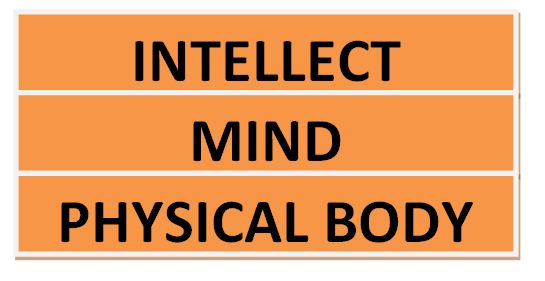
Intellectual layer: All of us individuals have an intellect (brain!!) which receives information, processes it, learns new facts, discriminates between right and not right and makes a decision. Planning, analysis, deciding processes etc are the functions of the intellect which makes decisions. So deciding on how you invest, how much to invest, planning our budgets etc. etc. are a process of the intellectual layer of our personality. (Alas, many do not fully use their intellectual abilities and just amber along, which is the subject of another post)

Now, this decision made by the intellect needs to be implemented!! In between the decision and the implementation come two more layers of our personality – our MIND (mental layer) and our BODY (physical layer of our personality). The mind is a fickle thing, has strong likes and dislikes, needs, desires, wants the easy way out (jugaad), is pulled by the various things of beauty and novelty in the world around! It is very strong and PULLS the body along with it. It is often working at a tangent different from the intellect.

To give an example, you have decided to take an early morning walk and set the alarm for 5.30 AM. The alarm goes off. Invariably the fickle, pleasure loving mind will want another 10 minutes more of sleep!! This snooze thing is a real killer and you never get up. But note what has happened. Your mind and body are opposing the decision of your intellectual layer!! Let this happen a few times and you will NEVER get up early. The same is the story with all new year resolutions!

Integration of our personality – when the intellect, mind and body are aligned

It’s easy now to see what we need to do but most difficult to implement. Integration of our personality is the complete alignment of our decisive intellects, our minds and the body. If the intellect works out a plan or even decides something small, the MIND SHOULD agree to implement without excuses and the body should be in alignment working towards our objectives, goals.  If not done, it will weaken your personality as you consistently negate yourself.

When investing, we often decide an asset allocation. If the market is shooting up wildly, see how our minds go crazy with dizzy excitement and does not implement the decision, justifying it instead - giving or making excuses!!! Looking objectively, you know this can be harmful. Many such examples can be given.

Exercises to practise: Simple methods have been given to practise integration of personality. Just make a start by being on time – ALWAYS. Being punctual is a proof of integration. Another good exercise to follow, is to positively give up some favorite food for a month and ensure that the craving mind and body follow!!

Successful living: The bottom line is to ensure that the discriminating, thinking intellect, the mind and body are in perfect alignment and harmony. Look around and see all instances of success. They did not happen purely by luck. The individuals have been decisive and with the different layers of their personality completely aligned towards their objectives. The adage – united we stand, divided we fall applies to layers of our personality. Ultimately it is we ourselves who are our own friends and our own enemies.

If you wish to invest in mutual funds through me, write to me . You can also message me on twitter @Invest_mutual

Mutual Fund investments are subject to market risk. Please read all scheme related documents carefully before investing.


Sunday, February 12, 2017

Empower Yourself - SM, a great tool you can use


The IFA Galaxy 2017 Annual Summit concluded yesterday and the theme was LEAP - Learn, Evolve, Adapt and Prosper.  The below is my piece published in the Annual Souvenir.

Empower yourself
(Social Media - a great tool you can use)

Many years ago, (maybe 20 years) as I was driving down Mount Road in Chennai, I saw a huge hoarding with an advertisement for the Economic Times that has I remember and recollect often. It had a picture of a ferocious canine looking down menacingly at a little cat that was sitting surprisingly calm, unafraid, staring right back! The caption of the advertisement read – THE POWER OF KNOWLEDGE. The picture made me stop driving and look again. The dog was chained to a post and could not move and the little cat was aware of it. This knowledge gave her the power to sit calmly and stare back!! Made me laugh then, but this has stayed with me.


The simple message from this – Knowledge IS power! Empower yourself through knowledge. In whatever field we are and whatever profession we follow, we can grow, evolve and adapt only if we have a continuous learning process in place.

Social media – a means to empower ourselves
As professionals, it is imperative to read, stay in touch, get information and in depth knowledge about every aspect of our business. I need not mention the various sources of getting information and means of knowledge, but wish to emphasize here on using social media as a wonderful means to empower oneself. I was surprised that someone suggested to advisors not to spend time on social media! We have five sense organs to gather knowledge from the world outside. I consider social media as a sixth sense organ we can use to get access to information. Those who do not use this great tool to learn and get ideas are simply shutting out one means of knowledge.

Bloggers today write on a range of topics - from personal finance basics to in depth analysis of securities, from detailing products and methods of investing to behavioral finance. These will give you far more knowledge than anything you read in the financial papers. Twenty odd years ago, the above advertisement pulled me to the paper, but in general, mainstream media often does not measure up these days with shallow and biased analysis. These are shared on various media.

Many on social media often mine data and give in depth commentary of major events like the budget which is often lifted by print and TV media. Media now-a-days lifts tweets of leaders etc. and presents this as news! In fact, the world gets to know future US Policy from the US President’s tweets only!    Unbelievable is the fact that information is available absolutely FREE to us when one pink paper is charging to read its stuff online.

In additions to the blogs we follow, twitter and facebook are simply a must to get a pulse of what is happening in your profession. Conversations of investors, commentators and analysts give a great insight on events and on regulatory developments. Unlike mails, you will almost certainly get a response on social media to a query you put to an expert. And, it is instant. I mean, imagine getting almost instant responses from a Professor of Finance at a Management Institute or from a fund manager! I have learnt more seeing the approach of fellow professionals on social media than from any relationship manager.

Are we clued on to the thoughts, needs of investors and clients? If you aren’t using SM well, you are simply missing out. Responses to a simple post on FB will give you more information that you think.

We are in a situation where the mutual fund industry is growing much faster than we thought it would. Investors are maturing in their outlook and there are big changes coming in the way the advice is given. Products are manifold. My simple message – among the various sources of knowledge, learn to use SM well. It will serve you well in the years ahead!


Monday, December 29, 2014

2014 - A good year for financial assets


2014 has a good year for financial assets. Investments in Equities including equity mutual funds and in debt – debt funds and fixed deposits have beaten inflation. Unless you had all you money in gold or gold funds, you have beaten inflation. Gold Funds gave a –ve return -6.10% as per Value Research.

This is a good time re-allocate you assets as per you financial plan. I am a firm believer in investing only according to a plan. Random investing to go along with the tide may be counter-productive in 2015. For 2015, stick to your plan and asset allocation. 

Debt

The returns from debt funds – have all beaten inflation. By November, WPI inflation was at 0 and CPI inflation at 4.38.

Given below is the performance of Debt Funds. Fixed deposit rates were about 9.00 – 9.50 % at the beginning of the year for deposits of > 3 years and those who had invested in debt / deposits have down well. The 8.75% returns for PPF and EPF in addition to beating inflation are tax-free. So we have had a year in which even debt has beaten inflation.

Debt – Income Funds
12.82
Debt – Short Term
10.49
Debt – Ultra Short Term
9.16
Gilt Funds – Long/Medium
16.40
Liquid Funds
8.76


Equities

Equities, especially mid-caps and small-caps, were the toast of the market. The BSE small-cap index was the top gainer at 66 per cent; the mid-cap index rose 51 per cent. The key benchmark indices, Sensex (on the BSE) and Nifty (on the National Stock Exchange), rose 29 and 30 per cent, respectively. These gains were despite about 2,000-point drop in 13 trading sessions between November 28 and December 17.

The below picture from the Business Standard gives a great snapshot.

Source: Business Standard
Returns from equity mutual funds - it has been good for Mutual Fund investors

Equity Large Cap Funds
34.69
Equity Mid and Small Cap
72.29
Equity Multi Cap
50.91
Equity ELSS
49.08
Hybrid Equity Oriented Funds
38.95

 However, international equity funds did not fare well and returned on an average 2.61% only. 

Gold

This picture from the Mint gives you a snapshot of how gold performed.


Real Estate:

It is difficult to analyse how real estate fared. However as per the NHB Residex, the performace this year hasn't been too great. While some pockets in some cities have fared well, overall real estate has not given the expected results this year. With piling inventory and stagnating sales, it remains to be seen how real estate will fare. See the below pic from the Business Standard. 


Finally, do your re-allocation now and keep investing systematically. 

Tuesday, December 23, 2014

Mission 5 crore +

Mission 5 crore +

Received a super response by mail to my post of 22.12.14. This is worth sharing.

“Thanks for your article – Be deliberate in your actions. I really like it and especially the part where a student you met, put down goals in writing and wrote – CAT 99 percentile. This really impacted me and I have today printed on a big paper – Retirement: Mission 5 Crore +

This is how I plan to go about and I have written in my diary. I am today starting an SIP of Rs 15000 a month for the 1st of the month for 15 years so that I can get about 75 Lakhs... in 15 years.  Every year I will increase by putting a new SIP of Rs. 5000. This is in addition to the PPF etc. that I have saved.

I wish to consult regarding….”

 “Till now, though I have been a good saver, I have not approached it like you wrote”

This is amazing - putting down the larger goal and details the steps towards achieving it!


It is heartening to note that writing has some impact and it underscores the need to be deliberate in your investments!

My twitter handle @invest_mutual

Monday, December 22, 2014

Year end reflections: In life or in investments - be deliberate in all your actions


The end of a year is always a good point to reflect… reflect on where you want to go and how you fared in the year gone by. As I started on a new life as a financial planner and trainer, it has been my good fortune to meet many people who have shared their wisdom with me.

One thing that came out in all my interactions, in knowing where I have gone wrong and where others erred…was that random actions and investments lead you nowhere.

The simple message for the new year -  Be deliberate in all your actions

Don’t let life’s waves lead you anywhere and toss you around. Even in your financial life, be completely  aware of what you are doing, where you are and where you want to go. Doing things deliberately means an awareness of your resources and the outcome of your actions.

A few people I met  made investment decisions without any deliberation, plan and at random, even on impulse - based on advertisements!!. This led to sub-optimal returns in a year which has been great for investments. A very young professional – 23 years old who saves about Rs 2 Lakhs a year was conned by an uncle into taking a money back policy for Rs 54000 per year!! No thought on what she wanted and what it entailed…

Being deliberate means the following:

First, it means – Having very clear goals and priorities:

There is no point in having vague goals like “ I want to be wealthy”. Your goals and priorities must be very clear. WRITE THEM DOWN.  For example,  a student I met had stuck a big piece of paper on her desk – CAT 99 percentile. As she got up every morning, the first thing she would see was her goal and every action during the day would be aligned towards that goal.

To reach anywhere in your financial life – first have goals and then prioritize them. What do you want from your life and how much money will get you what you want.  Then comes the planning part…to decide how each financial goal will be achieved.

Only if you know what you do, can you be deliberate - Make an effort to increase your knowledge

It is an investor’s  responsibility to have a basic understanding of investment products, know where to invest, for how long, how much, and why. Even investors who prefer to stay with simpler products should study their investment choices.

Many investors don’t like to read stuff on finance but you should at least know the basics. Today it is very easy to get a basic idea of financial products. Social media is a great place to get knowledge of the instruments you want to invest in. Having a basic understanding of financial products will help take informed decisions. You should have the ability to understand some details such as tax and net returns of every product. Working knowledge is good for a start.

 Now, as a consequence of the basic knowledge you have gained…

Invest only in products you understand:

To create wealth in the long run, you do not need to do anything stupid and invest in products, schemes that your “more intelligent” peers do. As long you don’t make blunders, you will find wealth building slowly but surely and all goals being reached. As a corollary – Do you understand the returns you are getting from products like insurance and the costs you incur?? If you do not then simply AVOID such products even if you brother-in-law assures you that all is great.

Being deliberate means…

Maintaining discipline in investing:

Automate and systematize your investing. This is the best way to maintain discipline in your investment. Keep a note of your cash flow – how much you earn, spend and save and you will see that by just being aware of your cash flow, you are doing the right things.

Being deliberate means, after the investments have been made…

Periodically monitoring your investments:

Being deliberate means being aware of where you have invested and monitoring regularly. It would be good to check if all the SIPs have gone through correctly and how the investments have fared. Monitoring would mean that you.

So, the final message – being deliberate in everything you do, including your investments will work wonders for you.

Do not hesitate to take the help of an advisor or planner if you wish to get a better direction. There are people with knowledge around and you can certainly take guidance. Taking such guidance would cost you a bit, but it is well worth the cost.

Wishing all a great and successful year ahead.


Thursday, November 6, 2014

RBI advice to banks on prevention of cheque related frauds


RBI, has noted that many cheque related frauds could have been avoided had there been proper checks by banks at the time of handling and/or processing the cheques and monitoring newly opened accounts.

In a recent circular to banks the RBI has advised them to review and strengthen the controls in the cheque presenting/passing and account monitoring processes and to ensure that all procedural guidelines including preventive measures are followed meticulously by the dealing staff/officials. Given below are some of the preventive measures suggested by RBI.

  • Ensuring the use of 100% CTS - 2010 compliant cheques. Under the CTS environment, electronic image of the cheque is transmitted to the drawee branch through the clearing house, along with relevant information such as data on the MICR (magnetic ink character recognition) band, date of presentation, and presenting bank. Cheque truncation obviates the need to move the physical instruments across branches
  • Strengthening the infrastructure at the cheque handling Service Branches and bestowing special attention on the quality of equipment and personnel posted for CTS based clearing, so that it is not merely a mechanical process.
  • Ensuring that the beneficiary is KYC compliant so that the bank has recourse to him/her as long as he/she remains a customer of the bank.
  • Examination under UV lamp for all cheques beyond a threshold of say, Rs.2 lakh.
  • Checking at multiple levels, of cheques above a threshold of say, Rs. 5 lakh.
  • Close monitoring of credits and debits in newly opened transaction accounts based on risk categorization.
  • Sending an SMS alert to payer/drawer when cheques are received in clearing.        

The threshold limits mentioned above can be reduced or increased at a later stage with the approval of the Board depending on the volume of cheques handled by the bank or it's risk appetite.

In addition to the above, banks have been asked consider the following preventive measures for dealing with suspicious or large value cheques (in relation to an account’s normal level of operations) :

a) Alerting the customer by a phone call and getting the confirmation from the payer/drawer.

b) Contacting base branch in case of non-home cheques.

The above may be resorted to selectively if not found feasible to be implemented systematically.

It has been reported that in some cases even though the original cheques were in the custody of the customer, cheques with the same series had been presented and encashed by fraudsters. In this connection, banks are advised to take appropriate precautionary measures to ensure that the confidential information viz., customer name / account number / signature, cheque serial numbers and other related information are neither compromised nor misused either from the bank or from the vendors’ (printers, couriers etc.) side. Due care and secure handling is also to be exercised in the movement of cheques from the time they are tendered over the counters or dropped in the collection boxes by customers.

Friday, October 3, 2014

Setting one's financial goals - make your goals a reality


Greetings on Dussehra!

This is an auspicious day for new beginnings and wishing you success in every endeavour, project. Every new project to be successful requires thoughtful planning and the same is true in our financial lives.

Necessity of financial goals

Any investment leads to an accumulation of assets that are primarily meant to be used, either by the investor or by the next generation. The presence of assets in a household's portfolio is to provide it support and security to deal with financial ups and downs and with income when regular salary or business income stops. 

The financial lives of investors can be divided broadly into the accumulation phase, when assets are built, and, the distribution phase, when assets are used. Typically, the distribution phase also represents a time when investors are unable to add to their assets. This phase is identified with old age and retirement when earning capability falls or completely vanishes. Therefore, building assets in the earning phase would mean a focus on maximisation of saving and investing capability.

Without goals, one will find it difficult to make the decision about how much should be saved and invested and where the the investment has to be made. You move from being a saver to becoming an investor when you define financial goals first and save with a specific purpose in mind. Framing objectives or goals is the first step in financial planning. Here are the important things to keep in mind while doing so.


Goals should be specific

It is important to set specific financial goals. A specific figure to be reached should be in mind. Write down your objective / goal. It should stare you in the face. Work out the desired amount required - "This is what I want in _____ years" . The time / duration in which you have to fulfill the goal should be  defined. Only then will you be able to figure out how much you need to invest and which financial instrument to choose. 

People tend to assign random figures for their goals without understanding whether the money saved will be sufficient or whether it will be feasible to put away a big amount. 


Financial planning should not be based on approximations and instinct. Specific goals facilitate a review later.

Attainanble

The goals should be attainable, reachable by mortals. You may not be in a position to hope for a house like Antilla! This also means that the goal is realistic,  actionable and not just a pipe-dream. 

Action Plan

Once the goal is set, an action plan to achieve the same must be clear. One has to save an amount to be invested annually, monthly. Investors have to first plan out how the savings target would be met. Several online calculators are available and you can arrive at the amount you need to save and the time available to achieve each of them. For example, a calculator would show that  Rs 48000 a month is required to be put in a recurring deposit at 9% for three years to save Rs 20 lakh as down payment for a house.

Next, there should be clarity about the investment instrument. As part of the action plan, it is best to automate the investment process i.e. an SIP into equity funds, RD into banks for short term goals etc. 

Every goal has a different time frame. So you need to match the investment avenue with the time available for that goal. If you have less than three years to save for your son's college admission, you should invest in debt rather than equity to ensure the safety of your capital . Your returns will be muted since debt instruments deliver about 8-9% but at least your capital will be safe and available when needed. If you are saving for retirement which is 20-25 years away, you should put a larger amount of savings in equity-oriented mutual funds. Equity investments are likely to yield higher returns in the long term, though there could be periods of volatility in between. 

Prioritise goals

Investors can have a big list of goals. However, each goal should be assigned a level of priority, depending on its importance, time horizon, financial impact on other goals, and the manner in which you will arrange the funds for it. For instance, buying health insurance is a more important and immediate need than buying a car. This will ensure that your other goals remain intact since a medical exigency will not wipe out your savings.

The way to succeed in your financial life is - Plan out your life and work out your plans!